You are riding through a neighborhood, along a striped bike lane on Classen, or pedaling across an intersection downtown when a driver runs a stop sign, swings open a parked car door, or turns across your path without signaling. The collision happens in less than a second. Cyclists have no seat belts, no airbags, and no steel frame around them, so the injuries that follow, including broken bones, head trauma, and road rash, can take months to treat and longer to recover from.
Oklahoma law treats people on bicycles as operators of vehicles on public roads. Drivers owe the same duty of care they owe other motorists, and when they breach it and injure a rider, full compensation is recoverable for medical bills, lost income, and the long-term effects of the crash. Bicycle accident claims share the legal framework of ordinary motor vehicle crashes but diverge sharply on injury severity and defense tactics. Hasbrook & Hasbrook Personal Injury Lawyers handles these cases on contingency.
For the full timeline of how an Oklahoma bike accident claim moves forward, see our overview.
Learn more about how to claim compensation after a bike crash from start to finish.
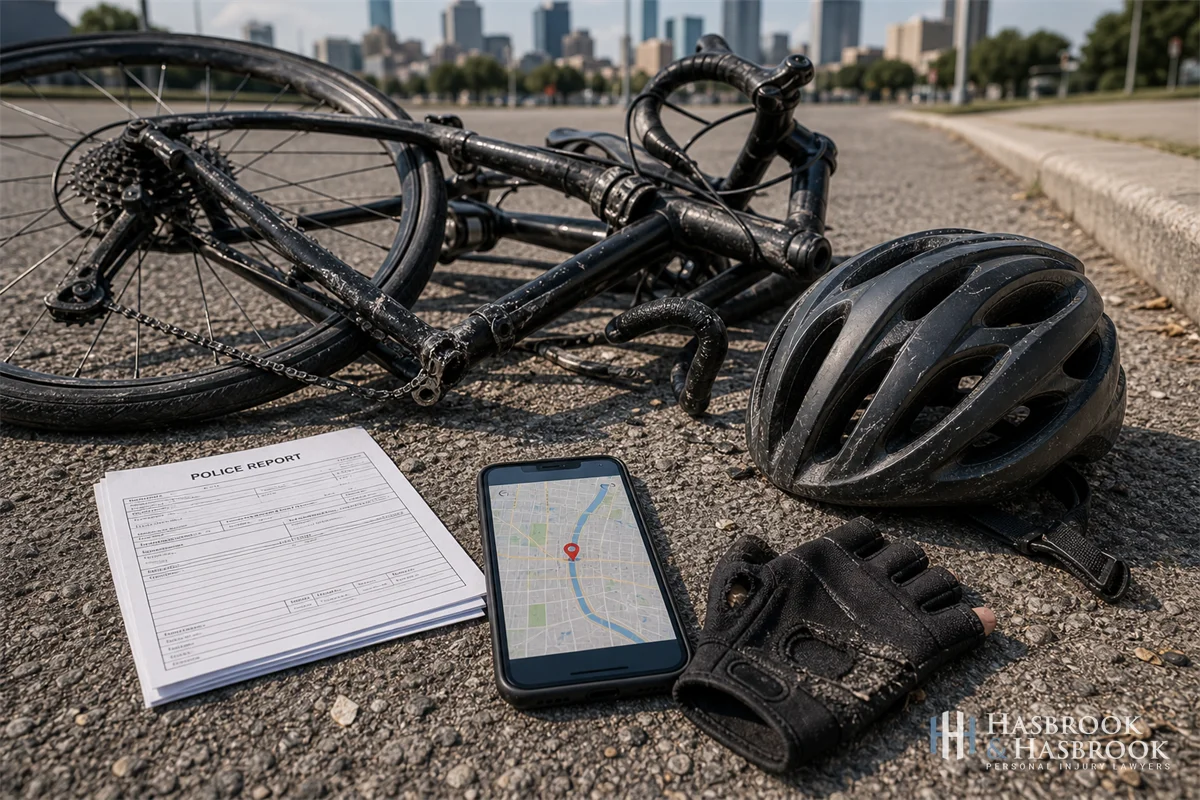
How bicycle accidents differ from other motor vehicle accident claims
Bicycle claims follow a different arc than ordinary fender benders. Four differences shape nearly every case:
- Injury severity is disproportionate. A 4,000-pound vehicle striking a 25-pound bicycle puts nearly all kinetic energy through the rider’s head, shoulder, hip, or spine. The CDC reports hundreds of thousands of emergency department visits annually, with head and brain injuries among the most common diagnoses.
- Driver perception bias is a defense theme. Insurers argue the rider was not visible. IIHS research finds drivers underestimate cyclist speed and miss riders even in daylight, so we gather conspicuity evidence (clothing, lighting, lane position, time of day) before the insurer frames the narrative.
- Comparative fault arguments are sharper. Helmet use, headphones, and visibility are all attacked aggressively. A small amount of cyclist fault swings a six-figure case meaningfully under Oklahoma’s modified comparative rule.
- The medical timeline is longer. Staged orthopedic surgeries, neuropsychological testing, and skin grafts mean nine to eighteen months to maximum medical improvement, so fast-track settlements almost always shortchange the rider.
Common causes of bicycle accidents in Oklahoma City
Most bicycle crashes in the metro share a small handful of fact patterns. Recognizing the pattern is the first step in proving the driver’s negligence.
Distracted and inattentive drivers
Drivers looking at a phone, adjusting infotainment screens, or not scanning the road cause a large share of bicycle crashes. A rider in a bike lane or at the edge of a travel lane is easy to miss for a driver who is not actively looking. Texting while driving is a primary offense in Oklahoma under 47 O.S. § 11-901d, and a citation strengthens the negligence claim. See our resources on distracted-driver crashes in the metro and texting-driver liability for the broader framework.
Failure to yield at intersections
Intersections are the highest-risk locations for cyclists. Drivers making left turns frequently fail to see or correctly judge the speed of an oncoming bicycle. Drivers running stop signs or red lights are a second major cause. The phrase defense lawyers hate to read in a police report is “I never saw the bike” because it admits the driver was not keeping a proper lookout. Our subpage on crash-cause coding used in OKC police reports walks through how officers tag intersection-error crashes.
Dooring, unsafe lane changes, and right hooks
Dooring occurs when a parked motorist opens a car door into the path of an oncoming cyclist. Unsafe lane changes happen when a driver moves right without checking the mirror. The right hook, where a driver passes a bicycle and immediately turns right across the rider’s line, is a frequent cause of serious crashes. In each scenario, the driver’s failure to check for cyclists is the operative negligent act.
Failure to give safe passing distance
Oklahoma City municipal ordinance requires drivers to allow at least three feet of clearance when overtaking a bicycle. A driver who buzzes a rider at less than that distance is committing a traffic violation, and a sideswipe at speed routinely produces the most catastrophic injuries in this practice area. Riders also share the road with commercial vehicles whose blind spots are larger and stopping distances longer; see commercial-vehicle crashes for that context.



Oklahoma bicycle laws and helmet rules that impact your claim
Oklahoma’s traffic code, found in Title 47 of the state statutes, governs how cars and bikes share the road. A handful of provisions come up in nearly every claim:
- Cyclists have the rights and duties of drivers. Under 47 O.S. § 11-1201, people operating bicycles on Oklahoma roads have the same rights and duties as motor vehicle operators.
- Required equipment. Under 47 O.S. § 12-609, a bicycle ridden after dark must carry a front white headlamp visible at 500 feet and a rear red reflector or red light visible at 600 feet. Equipment-statute compliance is a frequent issue at dawn, dusk, or night.
- Helmet rules. Oklahoma has no statewide helmet law for adult cyclists. The absence of a helmet does not make the rider negligent per se, but it can become a damages argument for head-injury components of a claim.
- Where you ride matters. Riding with the flow of traffic, using marked lanes, signaling turns, and obeying signals strengthen the rider’s position in comparative fault. Riding against traffic is the single most common rider behavior defense lawyers exploit.
| Driver conduct | Statute or rule | Effect on liability |
|---|---|---|
| Texting at the wheel | 47 O.S. § 11-901d | Primary offense; citation supports negligence per se |
| Failure to yield turning left | Title 47 traffic code | Driver typically presumed at fault absent rebuttal evidence |
| Passing closer than three feet | OKC municipal ordinance | Traffic violation; supports breach element |
| Dooring without checking | Title 47 traffic code | Direct breach of duty owed to cyclists in adjacent lane |
| Right hook after passing | Common-law negligence | Failure to maintain lookout; strong liability case |

What rights do bicyclists have in Oklahoma?
Riders on Oklahoma roads have the same right to use the lane that any other vehicle does, plus a few protections specific to bicycles:
- Right to occupy the lane when conditions, hazards, or lane width make sharing unsafe. Drivers behind must wait for an opening to pass safely, not crowd the rider.
- Right to use bike lanes free from motor vehicle intrusion. A driver who enters a marked bike lane to pass, park, or turn has almost certainly committed a traffic violation that supports a negligence claim.
- Right to ride two abreast in some conditions on roads where doing so does not impede traffic flow.
- Right to ride on most public roads: city streets, county roads, and state highways outside controlled-access freeways. Local rules vary on sidewalk riding.
- Right to recover damages on the same legal footing as a motorist: a driver who injures you owes the same duty of care, and you can pursue the same damages categories that any car-on-car claim would produce.
How do you prove fault in a bicycle accident case?
To establish that a driver is liable for your injuries, you generally need to show four elements:
- The driver owed you a duty of care on a shared road
- The driver breached that duty through a specific act or omission, such as failure to yield, unsafe lane change, running a signal, dooring, or right hook
- The breach caused the collision and your injuries
- You suffered injuries and damages as a result
Evidence that supports those elements includes the police report, photographs from the scene, dashcam or surveillance footage, witness statements, and medical records documenting the injuries from the date of the crash forward. Establishing the driver’s specific error through physical evidence (skid marks, point of impact, vehicle damage patterns) is often what separates a resolved case from a contested one. For a deeper walkthrough of liability mechanics, see our breakdown of the four duty-breach-causation-damages elements applied to motor wrecks and our resource on how fault is determined in traffic crashes.
Comparative fault and how it affects recovery
Oklahoma follows a modified comparative fault rule under 23 O.S. § 13. If a finder of fact finds the rider was partially at fault for the crash, damages are reduced by that percentage. If rider fault exceeds 50%, recovery is barred. At 50% exactly, the rider may still recover proportionately. Our explainer on how Oklahoma juries actually apportion shared blame walks through what happens in disputed cases.
Common defense fault arguments and how we counter them
- “You ran a stop sign.” Counter with intersection camera footage, witness testimony, and the officer’s diagram. A citation against the driver but not the rider is strong rebuttal evidence.
- “You were riding against traffic.” Counter with scene photographs, debris field showing point of impact, and surveillance footage if available.
- “No helmet, so the head injury is your fault.” Counter with neurosurgeon testimony that helmet protection has limits at the speeds and angles involved, and the brain injury would have occurred regardless.
- “Headphones prevented you from hearing the vehicle.” Counter that the rider had no duty to hear an approaching vehicle as long as visual lookout was maintained; the driver’s duty to avoid is independent.
- “You were not visible.” Counter with photographs showing clothing color, lighting, and equipment compliance under 47 O.S. § 12-609.
Building a strong bicycle accident claim
Evidence that matters most in the first 48 hours
The first 48 hours after a crash are when the most important evidence is preserved or lost. Take these steps as quickly as your medical condition allows:
- Police report: Always request a report at the scene. It captures the driver’s statements, citations, and the officer’s assessment of fault. Drivers must provide identification and insurance information under 47 O.S. § 10-104.
- Scene photographs: Damaged bicycle, road conditions, skid marks, the vehicle, and visible injuries from multiple angles.
- Surveillance and dashcam footage: Request in writing within the first week; retention periods are often 30 days or less.
- Witness information: Names, phones, and emails for anyone who saw the crash, including pedestrians and other cyclists.
- Same-day medical records: Document injuries the same day. Delayed treatment creates gaps the defense will exploit.
Medical documentation requirements
Common injuries in serious bicycle crashes include traumatic brain injury, broken collarbone, fractured pelvis, road rash with underlying tissue damage, and spinal injuries. A complete medical record chain from the emergency room through specialist care and physical therapy is the evidentiary backbone of the claim. For head-trauma claims, our hub for closed-head and concussion case workups covers diagnostic standards and damages categories; for cord-level injuries, see our hub for paraplegia and quadriplegia claim handling. Keep a written symptom log throughout recovery (pain levels by day, sleep disruption, missed work, activity limits) so contemporaneous notes are available at deposition.
Working with accident reconstruction
For high-stakes cases, particularly those involving a disputed point of impact, a forensic engineer who specializes in collision dynamics can examine vehicle damage, scrub marks, debris pattern, and biomechanics to produce a defensible account of the crash. We bring in reconstructionists when liability is contested or when injuries are catastrophic enough that the defense will fight every dollar.


Compensation for bicycle accident injuries in Oklahoma City
Oklahoma law allows recovery for all economic and non-economic losses caused by the driver’s negligence.
- Economic damages: past and future medical expenses, lost wages, loss of earning capacity, and out-of-pocket costs (replacement bicycle, gear, transportation during recovery, home modifications for permanent injuries).
- Non-economic damages: pain and suffering, loss of enjoyment of life, scarring and disfigurement (especially relevant for severe road rash), and emotional distress. Our subpage on calculating pain and suffering walks through the multiplier and per-diem methods adjusters and juries use.
- Punitive damages when the driver’s conduct rises beyond ordinary negligence to recklessness (drunk driving, drag racing, fleeing the scene). Our page on when punitive damages apply in Oklahoma car wrecks explains the standard.

Factors that increase your recovery
- Traumatic brain injury, spinal cord damage, or other injuries with permanent effects
- Significant scarring or disfigurement from road rash or surgical repair
- Long-term loss of earning capacity where injuries prevent a return to the same occupation
- Clear driver negligence with no plausible comparative fault argument
- Driver impairment, distraction, or a prior record of traffic violations
- Strong scene evidence (video, photographs, multiple witnesses)
Factors that reduce compensation
- Any finding that the rider violated a traffic law immediately before the crash
- Failure to wear a helmet on head-injury components of damages, in fact patterns where helmet use is medically relevant
- Gaps in medical treatment suggesting injuries were minor or resolved quickly
- Inadequate documentation of wage loss or other economic damages
- Social media posts inconsistent with the claimed level of impairment
How long do you have to file a bicycle accident claim in Oklahoma?
Oklahoma’s general personal injury statute of limitations is two years from the date of the crash, set by 12 O.S. § 95(A)(3). For injured minors, the period generally runs from the child’s eighteenth birthday under 12 O.S. § 96. Three situations shorten or modify the deadline:
- Government-vehicle defendants. The Governmental Tort Claims Act applies. Notice of claim is due within one year of the crash under 51 O.S. § 156, and a separate 180-day suit-filing deadline runs after the agency denies the claim under 51 O.S. § 157. Missing GTCA notice ends a claim against a government defendant entirely. See our page on crashes with city, county, or state-driven vehicles and the GTCA notice trap.
- Wrongful death. If a rider dies from crash injuries, the wrongful death claim has its own two-year limit under 12 O.S. § 1053, running from the date of death. See our hub for surviving-family claim representation under § 1053.
- Hit-and-run cases. The discovery rule occasionally extends the deadline when the driver is identified late, but the safer course is to start the claim immediately regardless of identification status.
How do insurance companies handle bicycle accident claims?
Insurers approach bicycle claims with a default skepticism toward the rider that does not exist in ordinary car-on-car claims. Three patterns repeat in nearly every adjustment:
- Quick low offers. Within days of the crash, before injuries are fully diagnosed, the carrier calls with a low offer framed as a courtesy. Accepting before reaching maximum medical improvement waives the right to additional compensation when complications emerge.
- Recorded statement requests. The transcript is mined for inconsistencies and used to anchor a comparative fault argument. You are not required to give a recorded statement to the other party’s insurer.
- Blanket medical authorizations. Carriers ask for years of pre-crash records, looking for any prior injury they can blame instead of the crash. The right scope is records related to the body parts injured in this crash, for a defined period.
If the at-fault driver carries the Oklahoma minimum policy limits and your damages exceed those limits, your own uninsured/underinsured motorist (UM/UIM) coverage becomes critical. UM coverage extends to bicycle riders under 36 O.S. § 3636, and Oklahoma allows stacking across multiple policies in some circumstances. See our resources on why you should carry UM coverage and what to do when the other driver is uninsured.
Mistakes that can hurt your bicycle accident claim
- Accepting an early settlement offer before injuries are fully known. Accepting before maximum medical improvement waives the right to additional compensation for ongoing costs.
- Giving a recorded statement to the driver’s insurer without legal advice. You are not required to give one.
- Delaying medical treatment. Treat the same day, even if injuries seem manageable; a gap is one of the most damaging facts in a bicycle claim.
- Failing to preserve the bicycle. Do not repair or dispose of the damaged bike until your attorney has reviewed and documented it.
- Posting about the crash on social media. Posts showing physical activity are used by defense investigators to contradict injury severity. See our resource on how social media can hurt a claim.
- Missing the GTCA notice deadline when a government vehicle is involved. The one-year notice window under 51 O.S. § 156 is unforgiving.
- Throwing away the helmet, lights, or damaged gear. All of it can become evidence on liability or damages. Bag and label everything.


Oklahoma City bicycle crash data and local risk factors
The Oklahoma Highway Safety Office tracks crash and fatality data for non-motorist road users statewide. OHSO publications document an annual count of bicycle injury crashes in Oklahoma County, with fatalities concentrated at urban arterial intersections rather than residential streets. National-level safety guidance from the NHTSA bicycle safety program tracks countermeasures that reduce crash risk: protected bike lanes, lighting, conspicuous clothing, and driver-awareness campaigns. Three local risk factors come up repeatedly in metro-area cases: arterials without dedicated bike infrastructure (NW 23rd, May Avenue, older sections of Pennsylvania); suburban-to-urban transitions where speed limits drop and driver scanning lags; and trail crossings at signalized intersections (Oklahoma River Trails, Hefner Trail, Bricktown system).
Common questions about bicycle accidents in Oklahoma City
Do I still have a case if I was not wearing a helmet?
Yes. Oklahoma has no adult helmet law for cyclists, so the absence of a helmet is not negligence per se. Defense counsel may argue head injuries would have been less severe with a helmet, which can affect damages on head-injury components, but the liability claim itself remains intact.
What if the driver who hit me was uninsured?
You can pursue a claim under your own uninsured motorist coverage if you carry it. Oklahoma allows stacking across multiple policies in some circumstances. If you do not have UM coverage, a direct lawsuit may still be viable, though collection depends on the driver’s assets. See what to do if hit by an uninsured driver.
How long do I have to file a bicycle accident lawsuit in Oklahoma?
Two years from the date of the crash under 12 O.S. § 95(A)(3). For minors, the clock starts on the eighteenth birthday. If a government vehicle was involved, GTCA notice is one year. See our breakdown of minority, incapacity, and discovery-rule tolling carve-outs for the deadline rules.
Can a passenger on the bicycle also file a claim?
Yes. A passenger has an independent claim against the at-fault driver. If the bicycle operator was also negligent, the passenger may have claims against both. Passenger claims follow the same two-year deadline and comparative fault rules.
Does wearing headphones affect my case?
It may. If headphones prevented the rider from hearing a warning and that contributed to the crash, it becomes a comparative fault argument. Recovery is barred only when rider fault exceeds 50% under the modified comparative rule. See our subpage on how juries split fault in OKC car cases.
What are the most common injuries cyclists suffer in these crashes?
Head injuries, including concussion and traumatic brain injury, rank among the most serious. Broken collarbones, fractured wrists, road rash requiring skin grafting, fractured pelvis, and spinal injuries are also common.
Can I sue the driver if I was hit in a bike lane?
Yes. A driver who enters a marked bike lane and strikes a cyclist has almost certainly committed a traffic violation and breached the duty of care. The bike lane designation strengthens the claim by confirming the rider’s lawful right to that space.
What if my child was hurt riding a bike?
Children injured by negligent drivers have the same recovery rights as adults. Minor-tolling under 12 O.S. § 96 gives injured minors longer to file. See our Oklahoma City child injury lawyer and what to do if your child is injured pages.
How do contingency fees work for these cases?
Cases at our firm are handled on contingency: no fee unless we recover. The fee is a percentage of the recovery, agreed in writing at the start. See our breakdown of contingency percentages and case-cost handling in Oklahoma and no-win-no-fee fundamentals.
Bicycle accident representation across the Oklahoma City metro
Our bike accident attorneys serve riders throughout the Oklahoma City area and across the state. Suburban and regional pages: cyclist representation in Edmond, bike-crash claims handled in Midwest City, our Moore bicycle-collision practice, and Tulsa-area cycling injury work. Bicycle accident lawyers handling these matters also work adjacent practice areas, since bike accident cases share legal and medical patterns with other vehicle-on-soft-target collisions: pedestrian accident representation in Midwest City, motorcycle accident attorneys in Edmond, our broader Oklahoma City car wreck practice hub, and our Oklahoma City catastrophic injury lawyer page when injuries are life-altering. Our practice areas page lists every injury type we handle, and the attorney profile for Clayton Hasbrook covers credentials and background.
How our Oklahoma City bicycle accident lawyer can help
Bicycle accident claims move through the same insurance and litigation framework as the standard auto insurance claim workflow, but the injuries are typically more severe and the comparative fault arguments more aggressive. Insurers routinely argue the rider was at fault, was not visible, or was not obeying traffic laws. We handle the full claims process: gathering scene evidence, working with accident reconstruction experts where needed, ordering and reviewing complete medical records, negotiating with the at-fault driver’s insurer, and filing suit when the settlement offer does not reflect the full damages. Our walk-through of filing through trial in an Oklahoma County district-court auto case covers each stage of litigation if a case does not settle.
Our firm is family-run and has represented injured Oklahomans for decades. Direct attorney access is the standard: call, text, or email anytime, and it reaches your lawyer, not a call-center queue. We send proactive case updates at every stage.


Speak with an Oklahoma City bicycle accident lawyer today
If you or a loved one was hurt riding in Oklahoma City, the next step is a free case review. Call (405) 605-2426 or submit your bike-crash details through the intake form. No fee unless we recover.